Liquid Clay: Forms in Flux – Maria Smigielska & Ana Ascic
Liquid Clay: Forms in Flux
Maria Smigielska & Ana Ascic
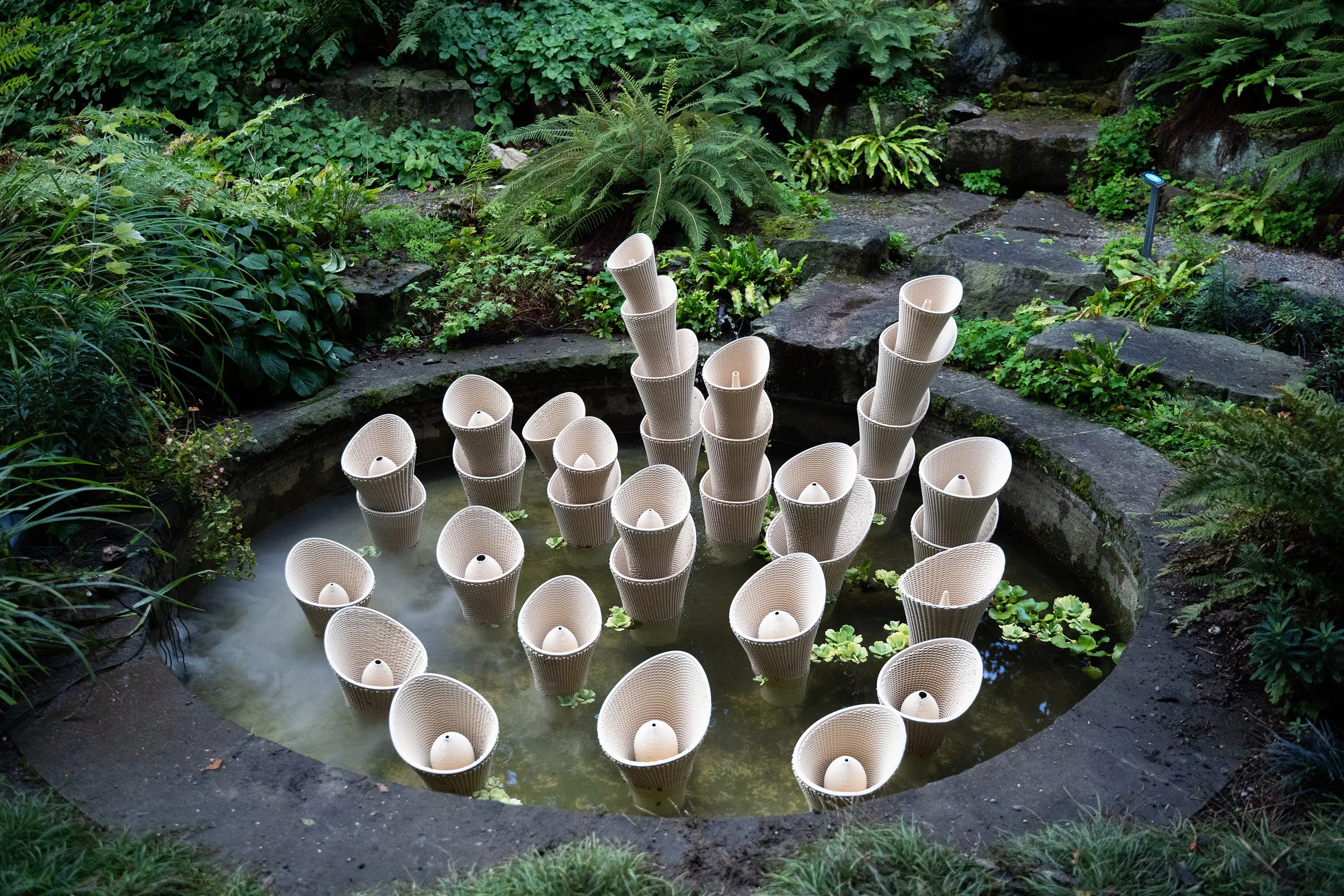
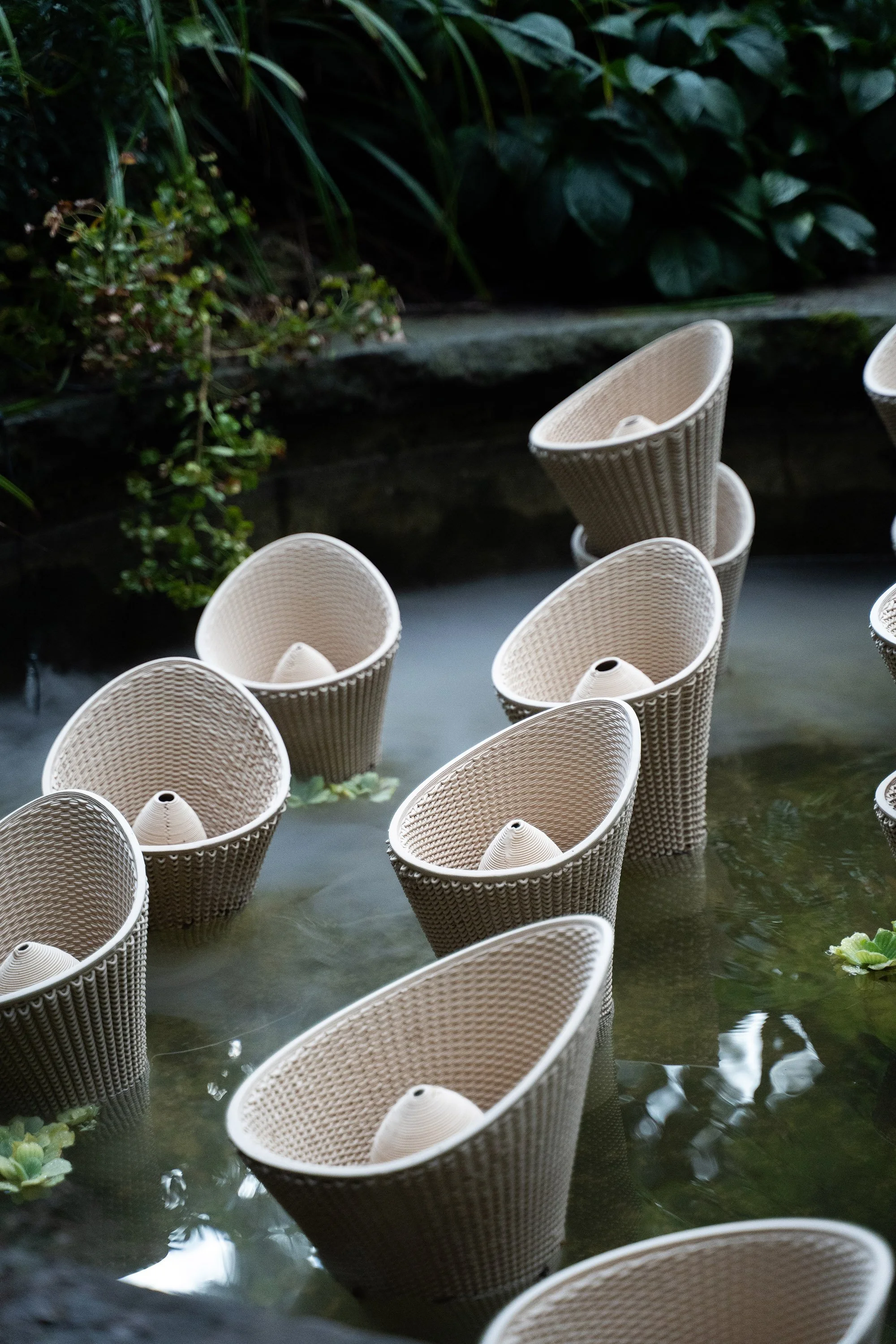
Inspiriert von Zürichs Beziehung zum Wasser und den natürlichen Formen aquatischer Pflanzen verbindet die Installation natürliche Prozesse mit digitaler Handwerkskunst. Aus dem Teich des Alten Botanischen Gartens erhebt sie sich mit 3D-gedruckten Tontrichtern, die an blütenartige Gefäße im Nebel erinnern, und formt eine Landschaft, in der Licht, Wasser und Form in einem kontinuierlichen Dialog mit ihrer Umgebung stehen.
Inspired by Zurich’s relationship with water and the natural forms of aquatic plants, the installation merges natural processes with digital craftsmanship. Rising from the pond of the Old Botanical Garden, its 3D-printed clay funnels evoke flower-like vessels in mist, forming a landscape where light, water, and form shift in continuous dialogue with their surroundings.
Maria Smigielska — Project Lead, Design & Development
Ana Ascic — Design & Development
Fabian Schmid — Production
Judyta Cichocka — Structural Advice
-
„Liquid Clay: Forms in Flux“ ist eine ortsspezifische Installation im runden Teich des Alten Botanischen Gartens in Zürich. Ausgehend von den Formen aquatischer Pflanzen – angepasst, um Wasser zu leiten und zu sammeln – übersetzt die Arbeit diese Logiken in ein skulpturales System aus 3D-gedruckten Tontrichtern. In wechselnden Rhythmen gestapelt, evozieren die modularen Elemente Muster von Wachstum, Erosion und Flussbewegung.
Das Projekt betont das Potenzial von Ton als nachhaltigem, lokal gewonnenem Material, das durch moderne digitale Fertigung neu interpretiert wird. Jedes Trichterelement wird präzise gedruckt und bewahrt zugleich die haptische Qualität der Tonlagen, wodurch ein Rhythmus entsteht, der zugleich natürlich und handwerklich wirkt.
Nebel, Spiegelungen und wechselndes Tageslicht beleben die Arbeit, verwandeln sie im Verlauf des Tages und schaffen eine sinnliche Erfahrung von Atmosphäre und Raum. Anstelle direkter Interaktion fungiert die Installation als skulpturale Intervention, die die Qualitäten des Gartens – Innehalten, Kontemplation und Verbundenheit – verstärkt.
„Liquid Clay: Forms in Flux“ ist eine behutsame Begegnung zwischen natürlichen Prozessen und digitalem Handwerk, die Besucherinnen und Besucher einlädt, über die gemeinsame Sprache von Wasser, Material und Form nachzudenken.
“Liquid Clay: Forms in Flux” is a site-specific installation in the round pond of Zurich’s Old Botanical Garden. Drawing from the forms of aquatic plants—adapted to channel and collect water—the work translates these logics into a sculptural system of 3D-printed clay funnels. Stacked in shifting rhythms, the modular elements evoke patterns of growth, erosion, and riverine flow.
The project highlights clay’s potential as a sustainable, locally sourced material, reinterpreted through advanced digital fabrication. Each funnel element is printed with precision yet retains the tactile character of layered clay, producing a rhythm that feels simultaneously natural and crafted.
Mist, reflections, and shifting daylight animate the work, transforming it throughout the day and offering a sensory experience of atmosphere and space. Rather than inviting interaction, the piece functions as a sculptural intervention that amplifies the garden’s qualities of pause, contemplation, and connection.
“Liquid Clay: Forms in Flux” is a gentle encounter between natural processes and digital craftsmanship, where visitors are invited to reflect on the shared language of water, material, and form.
Fragebogen Questionary
Wie sieht Euer Arbeitsplatz aus?
Maria: Es ist eine Landschaft aus Skizzen, Notizen, Materialien, Kabeln und digitalen Spuren - oft flankiert von 3D-Druckern oder Robotern, ob in einer Produktionshalle, einem Ausstellungsraum oder im Wohnzimmer.
Ana: Zwischen digitalem Modell, Produktionshalle und Spaziergängen in der Natur.
Wie würdet Ihr Euren Stil beschreiben?
Ana: Poetisch, prozessorientiert, basierend auf der Natur und dem digitalen Handwerk.
Welche Veränderungen erlebt Ihr in der Designwelt?
Maria: Eine stärkere Konzentration auf die Themen Nachhaltigkeit, verantwortungsvoller Materialeinsatz, Widerstandsfähigkeit gegenüber dem Klimawandel und Unsicherheit über die Zukunft.
Ana: Steigendes Interesse an regenerativen Materialien, transdisziplinärem Denken und offenen Herstellungsmethoden.
Wo findet Ihr Inspiration?
Maria: Beim Besuch von Ausstellungen, beim Lesen von Büchern und bei anregenden Diskussionen. Auch in den Lücken zwischen den Disziplinen.
Ana: In botanischen Strukturen, Lehmtraditionen, zukünftigen Ökologien, Zusammenarbeit.
Was macht Ihr in fünf Jahren?
Maria: Akademische Forschung, Lehre und Praxis zu grösseren Installationen und Kunst im öffentlichen Raum verschmelzen.
Ana: Grosse öffentliche Installationen entwerfen und digitales Handwerk unterrichten.
Wie sieht bei Euch ein normaler Designprozess aus?
Maria: Iterativ und nichtlinear, aber immer mit einem Funken und wiederkehrenden Fragen.
Welches sind Eure wichtigsten Arbeitswerkzeuge?
Maria: Neugierde.
What does your workspace look like?Maria: It’s a landscape of sketches, notes, materials, cables, and digital traces – often flanked by 3D printers or robots, whether in a production hall, an exhibition space, or the living room.
Ana: Somewhere between digital models, factory floors, and walks in nature.
How would you describe your style?
Ana: Poetic, process-oriented, rooted in nature and digital craftsmanship.
What changes are you observing in the design world?
Maria: There’s a growing focus on sustainability, responsible material use, climate resilience, and an increasing uncertainty about the future.
Ana: There’s rising interest in regenerative materials, transdisciplinary thinking, and open-source approaches to making.
Where do you find inspiration?
Maria: In exhibitions, books, and stimulating conversations – often in the gaps between disciplines.
Ana: In botanical structures, earthen traditions, future ecologies, and collaboration.
What will you be doing in five years?
Maria: Combining academic research, teaching, and practice to create large-scale installations and public art.
Ana: Designing large public installations and teaching digital craftsmanship.
What does a typical design process look like for you?
Maria: Iterative and nonlinear – but always with a spark and recurring questions.
What are your most essential tools?
Maria: Curiosity.
Über About
Ana Ascic ist Architektin und erforscht die Schnittmenge von digitalem Design und natürlichen Materialien. Beim Holzbauunternehmen Blumer Lehmann beschäftigt sie sich mit komplexen Holzgeometrien und erforscht 3D-gedruckten Ton.
Maria Smigielska ist Architektin und erforscht neue Technologien, die beeinflussen, wie wir die gebaute Umwelt gestalten, materialisieren und mit ihr interagieren. Derzeit forscht sie zu digitalem Holzhandwerk an der Berner Fachhochschule Architektur, Holz und Bau. Zudem unterrichtet sie an der Hochschule für Gestaltung und Kunst Basel FHNW und betreibt eine eigene Praxis mit Schwerpunkt Kunst und architektonische Installationen.
Ana Ascic is an architect exploring the intersection of digital design and natural materials. At the timber construction company Blumer Lehmann, she works with complex timber geometries and investigates 3D-printed clay.
Maria Smigielska is an architect researching new technologies that shape how we design, materialise, and interact with the built environment. She is currently conducting research on digital woodcraft at the Bern University of Applied Sciences, Architecture, Wood and Civil Engineering. In addition, she teaches at the Academy of Art and Design FHNW in Basel and runs her own practice focusing on art and architectural installations.